

Catenary and String Lighting: Designing Overhead Light for Outdoor Spaces
Design Tips & Techniques | October 30, 2026 | The Lighting Exchange
Catenary lighting looks effortless once it's installed — a simple line of light suspended overhead — but the physics holding that line up, and the engineering behind keeping it there through wind and weight, is far more deliberate than the finished result suggests.
What you'll find in this article: how catenary systems are actually engineered to carry load safely, what separates catenary from simple string lighting, and what to confirm before specifying an overhead lighting installation.
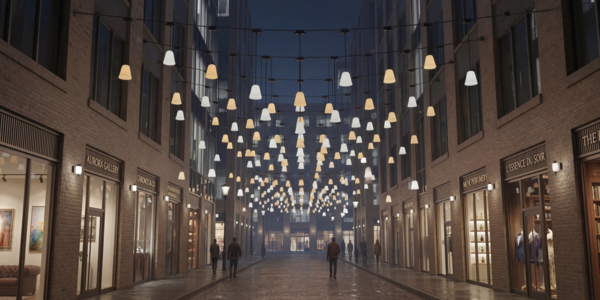
A catenary curve — the natural drape of a cable suspended between two points — is one of the oldest structural shapes in engineering, borrowed from suspension bridges and now used to hang light across plazas, courtyards, and pedestrian streets. The visual effect is simple. The structural planning behind it isn't.
What separates catenary from simple string lighting
- Catenary lighting uses a dedicated structural steel cable, engineered specifically to carry the tension and load of the system, with light fixtures or strands attached to or run alongside that cable
- String lighting typically integrates the light source directly into the suspension line itself, without a separate structural cable — fine for lighter-duty residential or temporary installations, but not built for the spans or loads catenary systems handle
- The distinction matters most at scale: a 15-foot backyard string run and a 150-foot plaza catenary span are solving genuinely different structural problems
How catenary systems are engineered to carry load
- The support poles or anchor points at each end of a catenary run need to be rated for the actual tension the cable will exert — this is a real structural calculation, not an estimate, and depends on span length, cable sag, and expected wind load
- Sag percentage (how much the cable dips relative to its span length) is a deliberate design choice: less sag increases tension on the anchor points, while more sag reduces tension but increases the visual drape
- Intermediate support points become necessary on longer spans to keep tension within what the end anchors can safely handle, rather than relying on a single unsupported run
What determines a catenary system's real-world durability
- Wind load calculations should account for the specific site's typical and worst-case wind conditions, not a generic assumption — an exposed plaza and a sheltered courtyard face very different loads
- Cable material and fixture housing both need weather and UV resistance rated for the system's expected service life outdoors, not just initial installation appearance
- Anchor point hardware, whether mounted to poles, buildings, or dedicated structures, needs periodic inspection, since it's carrying continuous tension load rather than a one-time static weight
What a specifier should know before designing a catenary layout
- Span length limits: most catenary systems have a maximum recommended span between support points before intermediate support becomes structurally necessary — this should be confirmed against the specific cable and hardware system being used, not assumed universally
- Grid vs. single-line patterns: a single catenary run suits a narrow street or walkway; a crossed grid pattern suits open plazas where light needs to spread across a wider area rather than along one line
-
Power distribution: longer runs need a clear plan for power injection points along the cable, since voltage drop over long low-voltage runs can dim fixtures at the far end of a run if not accounted for in the electrical design
Where it belongs
- Pedestrian streets, courtyards, and plazas wanting overhead ambiance without permanent overhead structure
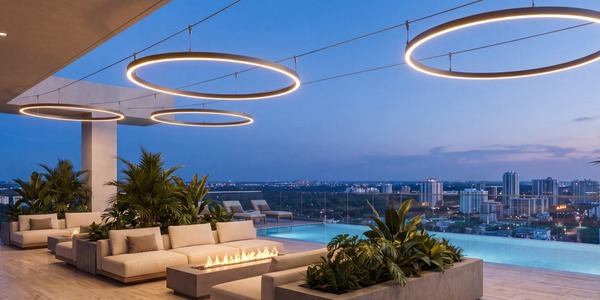
- Hospitality and retail outdoor spaces, where catenary lighting creates a defined, intimate atmosphere over dining or gathering areas
- Public spaces layering catenary with RGBW or tunable white control for both everyday ambiance and event-driven lighting scenes
Catenary lighting earns its visual simplicity through real structural planning — span, sag, tension, and anchor strength all have to work together before the first light ever goes up.
FAQ
What's the real difference between catenary and string lighting? Catenary systems use a dedicated structural cable engineered to carry real tension and load across longer spans; string lighting integrates the light source into the suspension line itself, suited to shorter, lighter-duty runs.
How long can a catenary span be without extra support? It depends on the specific cable and hardware system, but most systems have a maximum recommended span before intermediate support points become structurally necessary — always confirm this against the manufacturer's engineering data.
Does catenary lighting need special anchor points? Yes — the poles, buildings, or structures anchoring the cable need to be rated for the actual tension the system will exert, which depends on span length, sag, and expected wind load.
Can catenary lighting be combined with RGBW or color-changing control? Yes — catenary systems are commonly paired with RGBW or tunable white control to shift from everyday ambiance to event-driven color scenes without changing the physical installation.
Does wind affect catenary lighting design? Significantly — wind load calculations specific to the site's actual conditions directly affect anchor point strength requirements and cable tension planning, and shouldn't be estimated generically.
Other News Content by:
Bullard Outdoor
Pole Luminaires: The Complete Specification Guide for Park, Urban, and Pathway Lighting
Featured Products | September 24, 2026 | The Lighting ExchangeUnderstanding Dark Sky Lighting — And Why It Matters
Featured Products | August 18, 2026 | The Lighting ExchangeSymmetrical vs. Asymmetrical Lighting — Choosing the Right Distribution for Your Project
Featured Products | July 10, 2026 | The Lighting Exchange