

Beam Angle Explained: Spot, Narrow, Flood, and Symmetrical Optics
Featured Products | October 30, 2026 | The Lighting Exchange
Two fixtures, same wattage, same housing, same finish. Point them at different subjects with the wrong optic, and one lights exactly what it should — the other wastes half its output on empty air or the night sky. The optic, not the wattage, is what actually determines whether a landscape lighting plan looks intentional or accidental.
Start With the Subject, Not the Fixture
Before picking wattage or housing, ask what you're actually lighting — a tall narrow object, a broad flat surface, or an area that needs even fill with no visible source.
|
Beam Type |
Angle |
The Subject It's Built For |
|
Spot |
10°–20° |
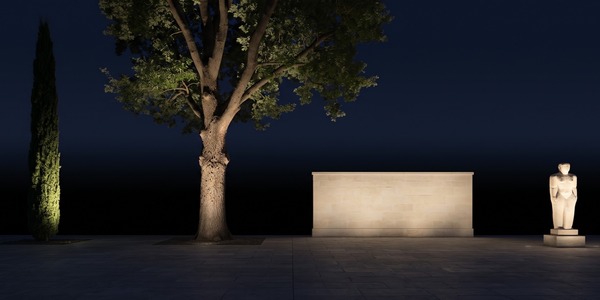
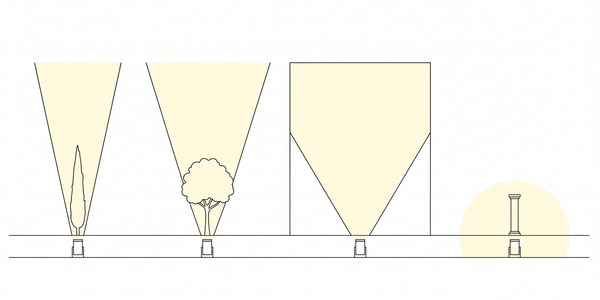
A single tree, a statue, a column — distance and drama |
|
Narrow |
20°–30° |
Same idea, more forgiving on uneven bark or stone texture |
|
Flood / Wide |
44°+ |
A wall, a hedge line, a building base — coverage, not isolation |
|
Symmetrical |
Equal in all directions |
Feature columns, sculpture, signage — deliberate, not incidental |
|
Soft light |
Not a beam angle at all |
Ambient fill and comfort lighting, not object-highlighting |
Why Soft Light Doesn't Belong on the Beam Angle Chart
This trips people up constantly: soft light isn't a narrower or wider version of the other four. It's a different mechanism entirely.
- Spot, narrow, and flood are all about beam width — how wide a cone of light leaves the fixture.
- Soft light is a diffusion treatment — a lens or reflector that blurs the LED's point source into a gentle glow, regardless of beam width.
- Where a spotlight directs attention toward something, soft light supports the space around it without directing attention anywhere in particular.
If the goal is highlighting an object, you want spot, narrow, or flood. If the goal is a comfortable ambient wash with no visible source, you want soft light — a genuinely different tool for a genuinely different job.
The Real Rule for Choosing Beam Angle
Distance and subject size decide beam angle, in that order:
- Narrow beams (10°–20°) suit tall, narrow subjects — columns, single trees, statues — or situations with a long throw distance.
-
Wide beams (44°+) suit broad, flat subjects — walls, ground planes, hedges — or situations with a short throw distance.
Get the beam angle wrong for the distance, and you either spot-light a wall (leaving most of it dark) or flood-light a single tree (washing out the drama the narrow beam would have created).
Why One Housing, Multiple Optics, Matters More Than It Sounds
A single fixture housing typically accepts multiple optic inserts. That means:
- The same fixture family can be specified across a project even as the beam requirement changes location to location.
- A contractor stocks fewer part numbers, since the housing stays constant and only the optic swaps.
- Design consistency holds across the site — visually identical fixtures, doing different optical jobs.
Why Adjustability Changes the Whole Calculation
Every fixture in Bullard's spotlight and inground collections rotates and tilts on-site after mounting — which means beam angle selection isn't a one-shot decision made at spec stage and locked forever.
- Trees grow. The aim specified on paper is rarely the aim needed three years later.
- Site conditions are rarely exactly as drawn, and adjustability absorbs that real-world tolerance.
- One SKU, correctly optic'd, can be re-aimed rather than replaced as a site matures.
Getting beam angle right at the start still matters — adjustability corrects aim, not beam width — but it takes the pressure off getting every angle perfect on day one.
FAQs
- What's the actual difference between spot and narrow beams? Spot runs 10°–20°, narrow runs 20°–30° — narrow is slightly wider and more forgiving on uneven or textured surfaces like bark or stone, while spot delivers the tightest, most dramatic contrast.
- Is soft light just a very wide flood beam? No — flood is still a directional beam angle, just a wide one. Soft light is a diffusion treatment that blurs the light source itself into a glow, independent of beam width.
- How do I know if I need narrow or wide for a given subject? Narrow suits tall, narrow subjects or long throw distances. Wide suits broad, flat subjects or short throw distances. Match the beam shape to the subject's shape.
- Can I change the optic without replacing the whole fixture? Yes — housings are designed to accept multiple optic inserts, so beam angle can often be changed without swapping the fixture body.
- If fixtures are adjustable, why does beam angle selection still matter? Adjustability changes aim direction, not beam width — a spot optic aimed at the wrong angle is still a spot optic. Getting beam type right at spec stage still matters; adjustability just corrects for growth and site tolerance afterward.
Other News Content by:
Bullard Bollards
Die-Cast vs. Extruded Aluminum: Choosing the Right Alloy for Outdoor Fixtures
Design Tips & Techniques | September 24, 2026 | The Lighting ExchangeSymmetrical vs. Asymmetrical Lighting — Choosing the Right Distribution for Your Project
Design Tips & Techniques | August 18, 2026 | The Lighting ExchangeSolar Security Bollards — A Smarter Way to Protect a Site
Featured Products | July 10, 2026 | The Lighting ExchangeSecurity Bollards: Life-Saving Architectural Infrastructure
Featured Products | June 03, 2026 | The Lighting Exchange