

How Many Cloudy Days Can a Solar Light Survive? Battery Autonomy Explained
Design Tips & Techniques | October 30, 2026 | The Lighting Exchange
It's the question every solar lighting buyer asks eventually, usually after their first genuinely gray week — will this thing still turn on tonight — and the honest answer depends on a design concept called autonomy, which most spec sheets mention only in passing.
What you'll find in this article: what battery autonomy actually means for solar lighting, how manufacturers design for cloudy-weather performance, and what to confirm before specifying a solar fixture for a climate with real weather variability.
A solar fixture doesn't need direct sunlight to charge — cloudy days still generate some panel output, just meaningfully less than clear skies. The real design question isn't whether a fixture works on a cloudy day; it's how many consecutive low-sun days the system can absorb before output actually suffers.
What "autonomy" actually means
- Autonomy refers to the number of days a fully charged battery can power the fixture at its rated output with zero or minimal additional charging — essentially, the system's cloudy-weather buffer
- A system designed for 3 days of autonomy can run through 3 consecutive heavily overcast or rainy days without meaningfully reducing light output, assuming it started from a full charge
- Longer autonomy requires more battery capacity relative to the fixture's nightly power draw, which is a real design tradeoff against cost and physical battery size
How manufacturers actually design for this
- Battery capacity is sized against the fixture's typical nightly runtime and power draw, with a safety margin built in specifically for reduced-sun stretches
- Many systems run at full brightness for several hours after dusk (when pedestrian or traffic activity is highest), then step down to a lower output for the remainder of the night — extending how long a given battery charge actually lasts
- Regional solar data factors into proper sizing — a fixture designed and sized for a consistently sunny climate may underperform its rated autonomy if installed somewhere with more frequent cloud cover, unless sizing accounts for that difference
What actually happens during an extended cloudy stretch
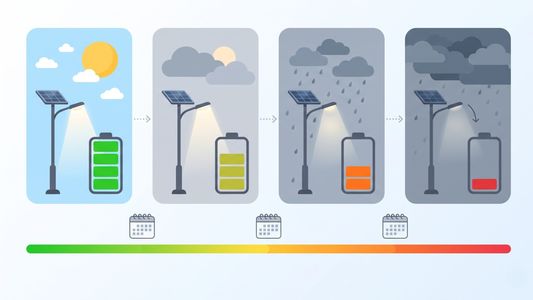
- As stored battery charge depletes below certain thresholds, many systems automatically reduce output to extend remaining runtime rather than running at full brightness until the battery is fully depleted
- This is a deliberate design choice — dimmer light for more nights is generally preferable to full brightness followed by complete darkness
- Systems with remote monitoring capability can report battery status, giving a facilities team visibility into whether a fixture is running low before it becomes a visible problem on-site
What determines whether a fixture will handle a specific climate well
- Local weather patterns: a region with frequent extended overcast stretches needs a fixture sized with more autonomy than one in a consistently sunny climate
- Winter daylight hours: shorter winter days mean less charging time even on clear days, which is often the actual limiting condition for sizing, not summer cloud cover
-
Battery chemistry: lithium batteries generally handle deep discharge cycles better than older chemistries, affecting both usable capacity and long-term battery lifespan under repeated cloudy-stretch cycling
What a specifier should confirm
- The specific autonomy rating for the exact product and region, not a generic manufacturer claim — autonomy is typically calculated against a specific location's solar data, and the same fixture can have different effective autonomy in different climates
- What happens to light output as the battery depletes, since a graceful step-down to lower output is a meaningfully different experience than an abrupt full shutoff
-
Whether remote monitoring is available, which turns "hoping the battery held up" into an actual visibility tool for maintenance planning
A solar fixture's real-world reliability during a genuinely bad weather week comes down to how thoughtfully its autonomy was calculated for the actual site — not just whether the spec sheet mentions cloudy-day performance at all.
FAQ
How many cloudy days can a typical solar streetlight handle? It depends on the specific product's autonomy rating, but a common design target across the industry is 3 to 5 consecutive days without significant recharge — always confirm this figure for the specific fixture and region.
Does a solar light completely shut off if the battery runs low? Many systems are designed to step down to reduced output as the battery depletes, rather than running at full brightness until an abrupt shutoff — this extends usable runtime during an extended cloudy stretch.
Does winter affect autonomy differently than a stretch of cloudy summer days? Yes, often more significantly — shorter winter daylight hours reduce daily charging time even on clear days, which is frequently the real limiting factor in proper system sizing, not summer cloud cover specifically.
Can autonomy be improved after installation? Generally not without physically upgrading battery capacity or panel size — autonomy is primarily a sizing decision made at the design and specification stage, not something adjustable after the fact.
Does remote monitoring actually help with cloudy-weather reliability? Yes, indirectly — it doesn't extend autonomy itself, but it gives a facilities team visibility into battery status, allowing proactive attention before a fixture's output visibly degrades on-site.
Other News Content by:
Bullard Solar
AOS Pro+ vs. SSLX Pro: Choosing the Right All-in-One Solar Light
Featured Products | September 24, 2026 | The Lighting ExchangeWhy We Build With Lithium — And Why It Matters
Featured Products | August 18, 2026 | The Lighting ExchangeWhy Adjustable LED Solar Lights Outperform Fixed Systems
Industry Topics | July 10, 2026 | The Lighting Exchange